Sunday, July 5, 2015

Establishing Professional Contacts and Expanding Resources

Establishing a global professional contact circle is becoming harder than anticipated.  I will continue to seek relationships across the globe with professionals in the field.  I am positive I will get at least one connection this coming week.  But in the mean time, I will also prepare to work on the alternate assignment.  I have found interesting in several of the podcasts available and look forward to listening to the NPR interviews.

The list of resources provided for in my current course were of familiarity to me such as Zero to Three.  Some new organizations that I find interesting to study for this course include the following:

Association for Childhood Education International

International Step by Step Association

I think that its important to study organizations from a more global lens, so I chose two organizations that stretches across the globe.  

I look forward to reading the newsletters for both organizations and exploring their sites to learn more about how each organization is supporting the early childhood community.  

Sunday, June 14, 2015

My Supports


Add caption
As an adult, an educator, mother and graduate student, I have come to recognize the importance of being supported in my life.  In a variety of aspects I rely on supports in order to make it through my day, and or specific experiences in my life.


Image result for family

 Being a single mom, I do a lot on my own, but I do receive a lot of support on a daily basis from my family members including my own children.  My sisters, mother, and my significant other help when they can in ways that I am internally grateful. Times in which, I need a sitter to attend an event or simply to get some "me" time.  The people in my family provide me with physical supports at times. 


Image result for friendship

My close friends are also very supportive.  They provide support by being a shoulder to cry on or just by listening to me vent.  They allow me to talk through challenges or stress that I may face.  It is with them that I receive the most valuable type of support, because I am able to keep my sanity. 


 Image result for teacher colleagues
 Collaboration is a number one component of effective teaching.  My colleagues are also a source of support.  I am able to share ideas, get feedback as well as engage in conversation with my colleagues on a daily basis when I'm in the field.  This support is also important to me, because it allows me to grow professionally and better my craft. 


 Image result for storm

If I had a challenge, such as if I got sick and couldn't work.  I definitely would need more physical support from my family and friends in order to do everyday things; taking my girls to school, running errands. I would need monetary support if it were for a long0term amount of time.  I believe I would also continue to need emotional support from friends and family as well.  I am the type of person that can get stressed by lifes woes and sometimes needs help with lifting my spirits.  I definitely would need emotional support to get through a life changing event as the described above . 

Sunday, May 31, 2015

My Connections to Play


One of my favorite things to do when I was a child was build a fort with sheets and pillows across a sofa or table or even on our bunk beds.  My sisters and I had limited opportunities to play outside, so we did majority of our playing indoors. I think that play was essential to my development in that it allowed me to interact with others, make friends, learn how to be a team player, learn how to win/lose, learn how to share and be patient.  All these things have been embedded into me as I grew older.  I think play is vital in teaching children some fundamental traits that will help in adulthood.


As a child, I enjoyed playing with my sisters and cousins, and other kids.  I did enjoy playing games such as:  tag, red light-green light, simon says, etc.  Those types of games that involved playing with others were a major type of play that I enjoyed.  I enjoyed playing with dolls, coloring/drawing/painting and jump roping a lot as a child.  Those are some things I would say were essential play items for my younger self.


Two Quotes That Represent Play During My Childhood


I think its important to know that play isn't necessarily meant to be organized and neat.  Sometimes it involves messing things up an being chaotic.  I really enjoyed arts as a child, which I continue to do as an adult.  Anything involving drawing, painting, creative expressions were always things I enjoyed doing.
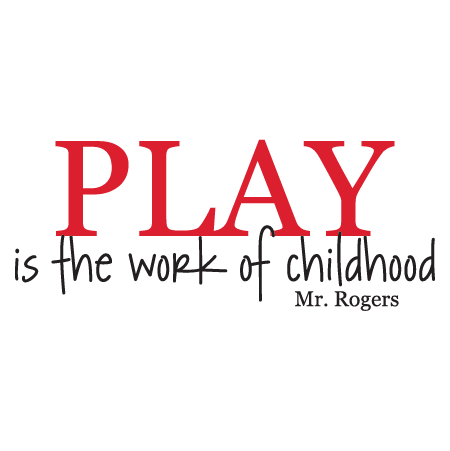


Any chance I got, I wanted to play.  My parents were quite strict and things had to be kept a certain way, so horseplay was limited to certain times and places.  I remember not always having as much time to play, but when given the chance, I made it my job to have fun.  I think to look at play as a "job" for kids is very valid, because children have no real control over much, but when it comes to their imagination and interacting with other kids, playing games, etc. it their job; their work.


I think play is still a major component of young childrens' lives, however I the age in which children decrease the amount of play is happening earlier. Technology, I feel is a major cause in the shift of the type of play that children are engaged.  Tablets, and cell phones have kinda replaced the more active forms of play that I was accustomed to.  I think that using technology is great for our young kids, but in moderation. Children nowadays should get out and engage in the type of play that involves being active more frequently.


Sunday, May 17, 2015

Relationship Reflection


Relationships are important to my overall health and well-being.  I believe that relationships, whether it be relationships that I have at home, work, the public, and globally are all essential in my growth as a human being. 

Relationships that fall within my home life to include: family members and close friends are my number one priority.  My children, significant other and family members/close friends are the people who impact my life the most and to which I make decisions.  Besides my children, two positive relationships that I have are with long-time friends, one that I met in high school and the other that I met in college.  They both impact my life in a positive way. We share common likes/dislikes, they are easy to talk to and bounce ideas off of, and they have shown consistency with regards being there for me. I think some reasons why these relationships are successful are because of several characteristics to include:  trust, spending time interacting with each other, and reciprocity in all aspects of the word.

Image result for relationships


Like all relationships, there are rough times, but we always seem to be there for each other, and not hold grudges or betray one another. 
I think on challenge to any relationship is being able to deal with the differences that each individual brings to the table.  Even though my two close friends and I have similar likes/dislikes, traits, etc., we still are individuals and don’t agree on everything. 

I believe that being able to recognize that every person has the right to have their own opinion and that you may have to agree to disagree on certain things will make relationships more successful.  I also, believe that the foundation of positive relationships begin with effective communication.  All relationships have to encompass effective communication skills from both parties.   Without communication, you will not be able to develop a relationship at all. 

Effective communication skills along with being an equal contributor can in turn help with being an effective early childhood professional in that we must build strong and positive relationships with the young children and their families that we serve.  


Image result for reciprocity

Sunday, April 26, 2015


Dear Fellow Classmates of EDUC 6160,

Thank you for all positive feedback that was given throughout this course.  I appreciate the time that you all made in sharing your thoughts and ideas through discussions and postings.  I wish continued success in your remaining courses.  

Denise


When I reflect on my studies so far, I think about the different milestones of development that we study in order to understand the whole child.  We look at what is typical for different stages and ages and we use that information to help guide instruction, to help inform parents and to simply provide support for young children and their families.  The above quote signifies that no matter what is typical for an infant, or child to do by a certain age, one should understand that children are unique and in their own way they will make gains.

Sunday, April 12, 2015

Testing for Intellignece


Reliability of assessments used to measure what students learn isn't reliable and therefore very limited.  There are many factors including, a student having testing anxiety, and language or cultural factors.  Using this as a means to scale students doesn't provide a full profile of the entire student.   It doesn't measure what children have actually learned nor does it bring into account the progress a student has made throughout the school year.  Real-world challenges and knowing how to preserve, work with others cooperatively and apply other skills cannot be measured from a test.  


There is so much pressure not only on the students taking the test, but also the teachers.  With the change in teacher accountability, more pressure is placed on teachers to work miracles or they job security is at risk.


Despite are practices to differentiate instruction to students we still asses them the same way as their non-disabled  peers.  As a special educator, I work with students with a variety of disabilities and learning styles, yet when it comes to standardized testing they are still expected to take.  This has always been somewhat of a challenge for me to comprehend.


“Finland--which is one of the top performers on international tests--has gone in the opposite direction”.  They don’t use standardized tests as often as the U.S.  Students there take more low states tests rather than high-stakes tests.  Students aren’t over-tested.  

http://www.huffingtonpost.com/2012/11/16/standardized-testing-a-fo_n_2145623.html