Sunday, October 4, 2015

Early Childhood Research Internationally


After exploring early childhood research for Australia, I found that they have similar issues to the U.S. in regards to the field of early childhood.  Australia’s early childhood organizations are working with the same mission as countries around the world, to “ensure quality, social justice, and equity for the care of young children.  Research issues stem from diversity to quality standards of early childhood programs, to the 
importance of play-based learning; which for Australia is mandatory under the National Quality Standard.  Australia has recognized the importance of early childhood education.  “Investment in early childhood education and care (ECEC) programs is a cornerstone policy of the Australian Government”. I found it intriguing that Australis offers universal access to early childhood education.   They are providing children with access to early childhood education programs for all children in the year before full-time schooling. “While attendance is not compulsory, early childhood education programmes are delivered in a range of settings including child care, stand-alone preschools and school-based preschools, in order to meet the needs of working families, and will be accessible to all Australian children, regardless of their location”. This is shocking to me due to the fact that as a country the U.S. is not doing that, not on a national level. 

References:

http://www.earlychildhoodaustralia.org.au/

https://education.gov.au/universal-access-early-childhood-education

Sunday, September 20, 2015

Positive Research

I just recently began working for Kennedy Krieger Institute as a Special Educator.  KKI is internationally known for its stellar care for children and adolescents with developmental delays such as Autism, learning disabilities, disorders of the brain, spinal cord and musculoskeletal system.  Significant and positive research has been completed over the years to help with better understanding of Autism, as well as development of effective methods of diagnosis and treatment.  Several KKI researchers are conducting numerous studies with efforts to to get gain a better understanding the causes of Autism and the systems to detect the earliest signs of Autism.

One specific example of how research in Autism has positively impacted children and families can be seen through the use of early diagnosis in children, which has aided in helping children receive behavioral therapy to improve speech and and behavior in children with Autism.


Sunday, September 13, 2015

My Personal Research Journey

When thinking of a topic to research, I find it intriguing to focus on The influence of family dynamics and structure on social/emotional development in young children   for my research simulation.  I have a strong desire to gain more insight on social/emotional development in children. As a special educator, I especially find it important to focus on this domain in early childhood development, due to my recent change professionally in working with students with autism whom have social/emotional weaknesses in a self-contained environment.
I’m looking forward to seeing if there are any indicators of family structure being having an impact on children from children; not necessarily with a disability but typical children. 
I think this research stimulation will help me with expanding my knowledge base with regards to social/emotional development, but also help me to service students with varied family structures. 


Sunday, August 23, 2015

Consequences of learning about the international side of the early childhood field.


Consequences of learning about the international side of the early childhood field.


1.      Awareness:  Being in the know of current issues and trends that affect children in other countries is important to the overall responsibility in which early childhood professionals as myself have pledged to do.  I believe that it’s important to know how that children from around the world are being supported not only because they deserve to be, but also because often time those same children end up as immigrants and may end up a student in my own class.

2.     Collaboration:  I think that the glory in working in this field, is that we are masters at sharing ideas and best practices.  So, to look at the international side of the early childhood field, and to share ideas with other professionals in other countries creates this human resource like no other.

3.     Helping towards the overall effort:  I believe that we must do all that we can to help spread how important early childhood education is.  We must do all that we can to push for early childhood initiatives in order to help young children get the support they need to develop.


Sunday, August 16, 2015

International Educational Organizations


I enjoyed exploring the ECCE section of UNESCO (United Nations Educational Scientific and Cultural Organization)’s website.  It provided for numerous examples on what the organization is doing to support early childhood education around the world.  One section in particular that I enjoyed reading was that highlighting a new book series launched in coordination with ADEA (Association with the Development of Education in Africa) that showcase experiences of African families.  The series covers topical subjects affecting the lives of African families that parents are sometimes reluctant to address. These include various topics such as war and conflict, the HIV/AIDS pandemic, the issue of water resources and environmental protection”.  The book series titled, “Bouba and Zaza and Childhood Cultures” is not only for families it can be used as a resource for educators to teach social, emotional and communication skills. “The book series addresses the glaring shortage of children’s books adapted to African contexts”.  With African being home to the “youngest population in the world, this book series is sure to help with early childhood global initiative efforts. 

Sunday, July 26, 2015

Sharing Web Resources Cont'd


I came across a section on ACEI’s website that highlighted a platform for individuals to have conversations and exchange ideas and experiences.


Goals of the Decade


•  Promote and protect childhood as a unique and critical stage of human development
•  Explore childhood from interdisciplinary and cross-cultural perspectives
•  Identify issues that erode childhood
•  Advocate for children's rights as a vital element of childhood
•  Translate the "Ten Pillars of a Good Childhood" into policies and practices that benefit all children


Within this section, it also showcased the Ten Pillars of Good Childhood, which relates exactly to my current professional development and service.  The pillars focus on important aspects that help to create the most optimal early childhood environment. 

The Ten Pillars of a Good Childhood


The Ten Pillars of a Good Childhood are a starting point that can be used to consider what a good childhood looks like today. Please use these pillars for your engagement with this decade. How are they relevant to the experience of childhood in your home, your community, or your nation? Share the Ten Pillars with others. We would like to hear your opinions about the pillars and about creative ways that the pillars have been used by you to guide policies and practices related to the experience of childhood.


  1. Safe and secure places for living and learning,
    with access to health care, clothing, shelter, and nutritious food
  2. Strong families and loving, consistent caregivers
  3. Social interactions and friendships
  4. Creative play and physical activity
  5. Appreciation and stewardship of the natural environment
  6. Creative expression through music, dance, drama,
    and the other arts
  7. Education that develops the full capacities of the child—cognitive, physical, social, emotional, and ethical
  8. Supportive, nurturing, child-friendly communities
  9. Growing independence and decision making
  10. Children and youth participating in community life.


Of the ten pillars, strong families and loving consistent caregivers, education that develops the full capacities of the child and creative play and physical activity stood out to me.  I believe that we need families to be involved just as much as those who service and advocate for children.  And we must work together with the families in order to have the greatest impact on a child’s life.  Developing the whole child and incorporating play and daily physical activity are also key points in the early childhood field. 


“Through collaboration and partnerships at local, regional, national, and international levels, we will extend our work, especially when enriched by insights across multiple sectors, including education, health, ecology, recreation, sociology, and psychology” (ACEI, n.d).  The platform in which professionals across different sectors can come together certainly allows for more of a collaborative approach for the issues and trends to be discussed in the early childhood field. 


Sunday, July 12, 2015

Sharing Web Resources


            http://acei.org/


This organization was founded to help promote education and support children around the globe.  This organization has been around for over 100 years, established in 1892 in UK and later expanding to its international name in 1946. 

“ACEI holds Consultative Status at the United Nations and membership in the NGO Committee  on UNICEF”


One current issues that stood out to me was their efforts to support children in different countries around the world. Currently there is a push to help support children in Costa Rica.


I also found it interesting to read about the news of a pending code of ethics. 
ACEI announced that it is developing an International Code of Ethics for Educators.  “It will be designed as a universal instrument that reflects internationally accepted humanitarian values, United Nation treaties, and other international agreements.  It may be adapted and applied by educators around the world as a tool for critical reflection and professional aspirations”. 


Sunday, July 5, 2015

Establishing Professional Contacts and Expanding Resources

Establishing a global professional contact circle is becoming harder than anticipated.  I will continue to seek relationships across the globe with professionals in the field.  I am positive I will get at least one connection this coming week.  But in the mean time, I will also prepare to work on the alternate assignment.  I have found interesting in several of the podcasts available and look forward to listening to the NPR interviews.

The list of resources provided for in my current course were of familiarity to me such as Zero to Three.  Some new organizations that I find interesting to study for this course include the following:

Association for Childhood Education International

International Step by Step Association

I think that its important to study organizations from a more global lens, so I chose two organizations that stretches across the globe.  

I look forward to reading the newsletters for both organizations and exploring their sites to learn more about how each organization is supporting the early childhood community.  

Sunday, June 14, 2015

My Supports


Add caption
As an adult, an educator, mother and graduate student, I have come to recognize the importance of being supported in my life.  In a variety of aspects I rely on supports in order to make it through my day, and or specific experiences in my life.


Image result for family

 Being a single mom, I do a lot on my own, but I do receive a lot of support on a daily basis from my family members including my own children.  My sisters, mother, and my significant other help when they can in ways that I am internally grateful. Times in which, I need a sitter to attend an event or simply to get some "me" time.  The people in my family provide me with physical supports at times. 


Image result for friendship

My close friends are also very supportive.  They provide support by being a shoulder to cry on or just by listening to me vent.  They allow me to talk through challenges or stress that I may face.  It is with them that I receive the most valuable type of support, because I am able to keep my sanity. 


 Image result for teacher colleagues
 Collaboration is a number one component of effective teaching.  My colleagues are also a source of support.  I am able to share ideas, get feedback as well as engage in conversation with my colleagues on a daily basis when I'm in the field.  This support is also important to me, because it allows me to grow professionally and better my craft. 


 Image result for storm

If I had a challenge, such as if I got sick and couldn't work.  I definitely would need more physical support from my family and friends in order to do everyday things; taking my girls to school, running errands. I would need monetary support if it were for a long0term amount of time.  I believe I would also continue to need emotional support from friends and family as well.  I am the type of person that can get stressed by lifes woes and sometimes needs help with lifting my spirits.  I definitely would need emotional support to get through a life changing event as the described above . 

Sunday, May 31, 2015

My Connections to Play


One of my favorite things to do when I was a child was build a fort with sheets and pillows across a sofa or table or even on our bunk beds.  My sisters and I had limited opportunities to play outside, so we did majority of our playing indoors. I think that play was essential to my development in that it allowed me to interact with others, make friends, learn how to be a team player, learn how to win/lose, learn how to share and be patient.  All these things have been embedded into me as I grew older.  I think play is vital in teaching children some fundamental traits that will help in adulthood.


As a child, I enjoyed playing with my sisters and cousins, and other kids.  I did enjoy playing games such as:  tag, red light-green light, simon says, etc.  Those types of games that involved playing with others were a major type of play that I enjoyed.  I enjoyed playing with dolls, coloring/drawing/painting and jump roping a lot as a child.  Those are some things I would say were essential play items for my younger self.


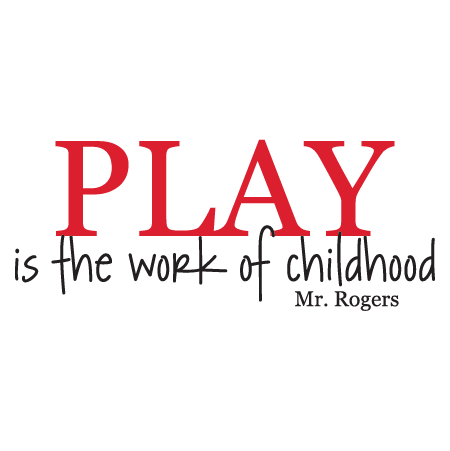
Two Quotes That Represent Play During My Childhood


I think its important to know that play isn't necessarily meant to be organized and neat.  Sometimes it involves messing things up an being chaotic.  I really enjoyed arts as a child, which I continue to do as an adult.  Anything involving drawing, painting, creative expressions were always things I enjoyed doing.


Any chance I got, I wanted to play.  My parents were quite strict and things had to be kept a certain way, so horseplay was limited to certain times and places.  I remember not always having as much time to play, but when given the chance, I made it my job to have fun.  I think to look at play as a "job" for kids is very valid, because children have no real control over much, but when it comes to their imagination and interacting with other kids, playing games, etc. it their job; their work.


I think play is still a major component of young childrens' lives, however I the age in which children decrease the amount of play is happening earlier. Technology, I feel is a major cause in the shift of the type of play that children are engaged.  Tablets, and cell phones have kinda replaced the more active forms of play that I was accustomed to.  I think that using technology is great for our young kids, but in moderation. Children nowadays should get out and engage in the type of play that involves being active more frequently.


Sunday, May 17, 2015

Relationship Reflection


Relationships are important to my overall health and well-being.  I believe that relationships, whether it be relationships that I have at home, work, the public, and globally are all essential in my growth as a human being. 

Relationships that fall within my home life to include: family members and close friends are my number one priority.  My children, significant other and family members/close friends are the people who impact my life the most and to which I make decisions.  Besides my children, two positive relationships that I have are with long-time friends, one that I met in high school and the other that I met in college.  They both impact my life in a positive way. We share common likes/dislikes, they are easy to talk to and bounce ideas off of, and they have shown consistency with regards being there for me. I think some reasons why these relationships are successful are because of several characteristics to include:  trust, spending time interacting with each other, and reciprocity in all aspects of the word.

Image result for relationships


Like all relationships, there are rough times, but we always seem to be there for each other, and not hold grudges or betray one another. 
I think on challenge to any relationship is being able to deal with the differences that each individual brings to the table.  Even though my two close friends and I have similar likes/dislikes, traits, etc., we still are individuals and don’t agree on everything. 

I believe that being able to recognize that every person has the right to have their own opinion and that you may have to agree to disagree on certain things will make relationships more successful.  I also, believe that the foundation of positive relationships begin with effective communication.  All relationships have to encompass effective communication skills from both parties.   Without communication, you will not be able to develop a relationship at all. 

Effective communication skills along with being an equal contributor can in turn help with being an effective early childhood professional in that we must build strong and positive relationships with the young children and their families that we serve.  


Image result for reciprocity

Sunday, April 26, 2015


Dear Fellow Classmates of EDUC 6160,

Thank you for all positive feedback that was given throughout this course.  I appreciate the time that you all made in sharing your thoughts and ideas through discussions and postings.  I wish continued success in your remaining courses.  

Denise


When I reflect on my studies so far, I think about the different milestones of development that we study in order to understand the whole child.  We look at what is typical for different stages and ages and we use that information to help guide instruction, to help inform parents and to simply provide support for young children and their families.  The above quote signifies that no matter what is typical for an infant, or child to do by a certain age, one should understand that children are unique and in their own way they will make gains.

Sunday, April 12, 2015

Testing for Intellignece


Reliability of assessments used to measure what students learn isn't reliable and therefore very limited.  There are many factors including, a student having testing anxiety, and language or cultural factors.  Using this as a means to scale students doesn't provide a full profile of the entire student.   It doesn't measure what children have actually learned nor does it bring into account the progress a student has made throughout the school year.  Real-world challenges and knowing how to preserve, work with others cooperatively and apply other skills cannot be measured from a test.  


There is so much pressure not only on the students taking the test, but also the teachers.  With the change in teacher accountability, more pressure is placed on teachers to work miracles or they job security is at risk.


Despite are practices to differentiate instruction to students we still asses them the same way as their non-disabled  peers.  As a special educator, I work with students with a variety of disabilities and learning styles, yet when it comes to standardized testing they are still expected to take.  This has always been somewhat of a challenge for me to comprehend.


“Finland--which is one of the top performers on international tests--has gone in the opposite direction”.  They don’t use standardized tests as often as the U.S.  Students there take more low states tests rather than high-stakes tests.  Students aren’t over-tested.  

http://www.huffingtonpost.com/2012/11/16/standardized-testing-a-fo_n_2145623.html

Sunday, March 29, 2015

Consequences of Stress on Children's Development


I know of many people who had to deal with socioeconomic issues growing up.  Poverty has and continues to be a serious issue in our country and around the world.  Those families that receive help through government assistance funds and programs are getting enough just to get by.  The people that I know who experienced poverty as children all said that at the time they were just kids and could only remember enjoying life as kid, the adults in the home made it so that they didn't worry about not having enough money, they made a way.  I think that sometimes especially nowadays we bombard our children with adult problems and put too much emphasis on them knowing that they aren't as well off as the next family.  I think that parents need to shelter their children as much as possible from knowing the details of how much they have or don't have and try to get as much resources that are available to them as possible.


I chose Syria as the country that I would like to know about, because of the war that is going on right now there.  I think that one stressor that was not on the list specifically but of course can fall under the category of Violence is war.  A child living through war is something that is indeed hard for me to believe, but it is definitely a reality for many children around the world and not just in Syria.  I think that.  Refugee camps for children and families are one of the ways in which people who are being affected by civil war in the countries are being supported.  Organizations like UNICEF are helping by raising donations.  I think that supporting when you can whether it monetary or through prayer and voice is a way that one can start to help.  


http://www.supportunicef.org/site/c.dvKUI9OWInJ6H/b.8298561/k.555F/Donate_to_help_the_children_of_Syria.htm

Sunday, March 15, 2015

Public Health Announcement

Image result for mental health

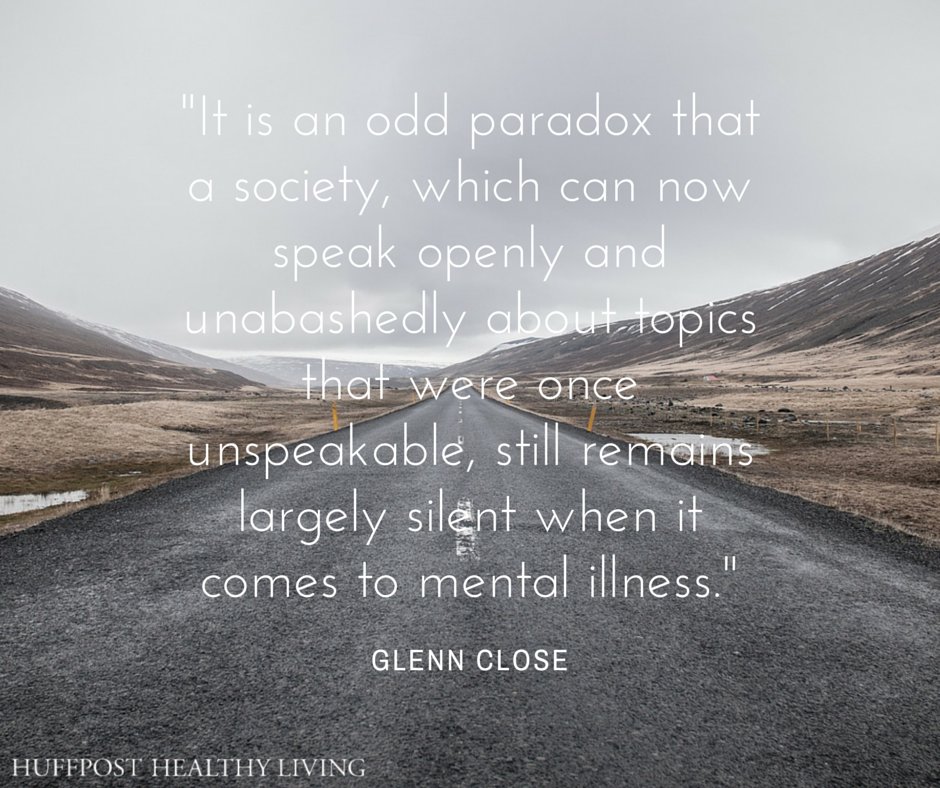
Mental health is a major public health concern, especially with the dark stigma that surrounds it.  With the statistic of 1 in 5 American suffering from depression at some point in their lives, we must not ignore the importance of mental health awareness.

Because relationships are how we as individuals interact with each other, we must recognize the effect of mental health on families and young children in general.  I chose this public health concern because of my experience working with students with emotional disturbances in the special education community.  These children face challenges within them selves involving self-control and anger management.  Often then not, these children have family members with mental health issues.   I think as professionals working with children and families that we help to increase the awareness of mental health in efforts to decrease the negative stigma that is associated while providing support to those children and families that are dealing with circumstances that may increase their risk of having mental health issues.

The stigma doesn't only hold true in the U.S., around the world individuals are remaining silent when it comes to mental health.  People fear reject, judgement and shame in disclosing that they have a mental illness.

http://www.everydayhealth.com/depression/mental-health-stigma-and-prejudice-strong-around-the-world-8505.aspx

Sunday, March 8, 2015

Birthing experience

This posting was a difficult one for me due to the fact that I think birth is a very private and personal experience.  So without going beyond my comfort level I will share that my personal birthing experience was in a hospital setting surrounded by my the people most closest to me including my best friend. I have two wonderful daughters who are 4 years apart and I have to say that both births were a blessing.  The first one was actually easier than the second one when it comes to the actual delivery. The second birth experience was longer and more painful due to it being natural. Nevertheless I am blessed beyond my measures in being able to carry and bring life into the world. In terms of birth and its impact on child development I recognize the importance of prenatal care as well as having a supportive family/friends to get through the experience. We say that young children need support and that it takes a village to raise a child but it doesn't just start from a certain age it begins prenatally. 

I read about birthing traditions and customs in Nigeria. In parts of Nigeria women are expected to give birth alone; completely by themselves. It is not till the delivery is over then a midwife and others come to support the mother. 

I could not even imagine going through birth by myself without another sole in the room with me. I think that the support I received from my family gave me the strength to make through the delivery. Also, I think that the mother feeling and knowing that she has support aids in child development because of the importance we must take in addressing the fact that raising a child takes many. 

Sunday, March 1, 2015

Thank you all for the kind words!  We all got through the first course in our program.  Everyone deserves a round of applause!

Best wishes to everyone as we move on to our next course.

Saturday, February 21, 2015

Examining Code of Ethics

"Professional and Interpersonal Behavior
3. We shall strive for the highest level of personal and professional competence by seeking and using new evidence based information to improve our practices while also responding openly to the suggestions of others".

"Enhancement of Children’s and Families’ Quality of Lives
1. We shall demonstrate our respect and concern for children, families, colleagues, and others with whom we work, honoring their beliefs, values, customs, languages, and cultures".

"Responsive Family Centered Practices
We shall empower families with information and resources so that they are informed consumers of services for their children".

The above ideals from NAEYC Code of ethics are ones that I believe are the most meaningful to me because they focus on what I need to do to prepare myself as a leader in the field, how I will work in collaboration with families (parents), and the golden rule in developing a positive relationship with young children and their families. 

Article: NAEYC. (2005, April). Code of ethical conduct and statement of commitment. Retrieved May 26, 2010, from
http://www.naeyc.org/files/naeyc/file/positions/PSETH05.pdf


"I-1.3—To recognize and respect the unique qualities, abilities, and potential of each child".

"I-1.8—To support the right of each child to play and learn in an inclusive environment that meets the needs of children with and without disabilities".

"I-1.9—To advocate for and ensure that all children, including those with special needs, have access to the support services needed to be successful".

The above ideals from DEC code of ethics. I found these ideals to be most meaningful to me because of ways I would like to serve children and their families. I believe that my main responsibility working with young children is to encourage them and see there potential. Also knowing that every child is different and had different strengths and weaknesses support the diversity that is each child to meet his or her individual needs. Lastly, advocating for students in a multitude of ways remains to be professional direction. 

Article: The Division for Early Childhood. (2000, August). Code of ethics. Retrieved May 26, 2010, from
http://www.dec-sped.org/


Sunday, February 8, 2015

Additional website and article resources


Website:  http://www.earlychildhoodnews.com/
                Center for National Black Child Development Institute www.nbcdi.org
                Center for Law and Social Policy www.clasp.org
                The Annie E. Casey Foundation (funds Kids Count projects in all states) www.aecf.org
                Center on the Social and Emotional Foundations for Early Learning                    
                        http://csefel.vanderbilt.edu/

 Article:  http://www.earlychildhoodnews.com/earlychildhood/article_view.aspx?ArticleID=255

                http://www.earlychildhoodnews.com/earlychildhood/article_view.aspx?ArticleID=525

Sunday, February 1, 2015

"The passion to make sure that all children are taught in environments and in ways that truly nurture their ability to grow and develop to their fullest” – Louise Derman-Sparks

Saturday, January 31, 2015

Help start a movement! Advocate!


"The fact that not only do you have to consider children as individuals, but you also have to consider children as members of groups with their own cultural identities." Susan Bredekamp

"Join the movement, your own journey is what really counts." Pamela Winton

Saturday, January 17, 2015

One of My Favorite Children's Books


One


I love this book!  Its messages of respect, getting along with others, and anti-bullying make for a great read-aloud for any age.  The use of colors and numbers can allow for use in early childhood lessons.  

Meaningful Quotes

Tuesday, January 6, 2015

Good evening,

First post to blog....Online learning will definitely be a learning curve, but I'm up for the challenge.